Chickens, Sparrows and Penises: Why the World's Slang Converged on Birds
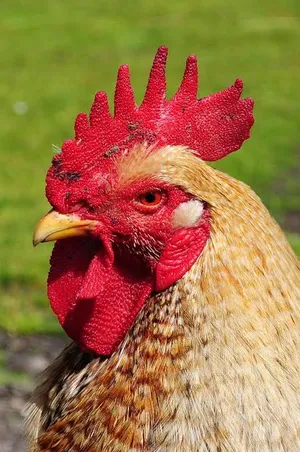
The slang word for the penis may be the most international word in any language. In English it is a cock, in German a Hahn, in Russian a петух, in Swahili a jogoo, in Vietnamese a chim, in Mandarin simply "chicken." In modern Greek, πουλί once meant "bird" — today its primary meaning is "penis." The idea that an ordinary barnyard fowl doubles as a name for the male organ appears across at least nine language families, from the Germanic languages of northern Europe to the Bantu languages of East Africa to the Austronesian languages of the Philippines. This is not a coincidence, and it is not a joke that happens to repeat itself. It is one of the most striking cases of convergent metaphor in the world's languages — and, strangely, one of the least studied.
image
The evidence of the pattern's reach is remarkable. The Latin poet Catullus, writing around 54 BC, famously addressed his girlfriend's sparrow — passer, in Latin — in terms that scholars have long read as a sexual double entendre; the bird-as-penis metaphor is therefore at least two thousand years old. Since then it has surfaced independently in Germanic (English cock, German Hahn, Danish kok), Slavic (Russian петух, Macedonian kur, Czech pták, whose ordinary word for "bird" doubles as crude slang), Romance (Spanish polla, Italian uccello), Hellenic (Greek πουλί), Sino-Tibetan (Mandarin 鸡), Bantu (Swahili jogoo), Austronesian (Ilocano kawítan), Tai-Kadai and Austroasiatic (Thai nok, Vietnamese chim), and Arabic dialects. The same shape keeps emerging in languages that have never been in contact.
Yet the pattern is not universal — and that is precisely what makes it scientifically interesting. Korean uses 고추, the word for chili pepper, as the childish euphemism for the organ. Japanese prefers ちんこ, an onomatopoeia that sounds like "ding-ding." Finnish and Hungarian reach for opaque swear words of unknown origin. These languages are doing exactly the same thing as English and Swahili — avoiding a taboo word by substituting a harmless everyday one — but they chose entirely different materials. The same human instinct, different local stock.
Why, then, did so many languages settle on birds? Cognitive linguists have argued since Lakoff and Johnson that metaphors arise from shared bodily experience, and if that is true, the same body should produce the same metaphors. The bird case supports the theory remarkably well, through four converging mechanisms. First, there is shape: the silhouette of an erect penis with its testes closely resembles the outline of a bird — Keith Allan, the leading scholar of taboo language, notes that "the similarity of the profiled penis-with-testicles to the outline of a bird gives rise to an image found in many languages." Second, there is timing: the penis rises in the morning at the same hour the rooster crows, a daily synchronized event that every man in history has experienced. Third, there is behavior: the rooster struts with a neck that thrusts like an erect organ, fights, and chases hens — a walking encyclopedia of male sexual display. Fourth, there is a semantic chain linking birds to procreation: the English word seed means both plant grain and semen, and the bird's pecking beak connects naturally to the act of sowing. The rooster, uniquely among farm animals, combines all four.
That last point explains why the bird won the global popularity contest over every other candidate. Chickens are the world's most widespread domestic animal — nearly every culture has kept them. The rooster is the only barnyard animal whose male characteristics are loudly external: the crowing, the comb, the aggression, the pursuit of hens. Pigs are dirty and slothful, cattle are slow and associated with females, horses are too large and distant, sheep are meek. The bird, meanwhile, is small, familiar, and one of the first creatures a child learns to name — which is why "little bird" works as a children's word for the organ in so many tongues, the way Mandarin's 小鸡鸡 is spoken by mothers to toddlers.
The exceptions complete the theory. The body supplies the direction — a taboo organ needs a harmless substitute — but not the specific value. Korean's chili pepper works on shape and heat; Japanese's onomatopoeia works on sound; the bird works because it is the most universally available object that is simultaneously a common animal, a passable silhouette, and a symbol of male vigor. All three are local implementations of one global mechanism. The mechanism is universal; the vocabulary is local.
What makes this worth studying is that the pattern sits at the center of a live debate in cognitive linguistics. If metaphors are driven by shared bodily experience, they should be universal — yet they visibly vary across cultures. The bird-as-penis metaphor is a perfect natural experiment: it has arisen independently dozens of times in unrelated language families, which is powerful evidence for the universality of bodily-driven metaphor. And yet the existing literature is thin — scattered entries in semantic-shift databases, a single paper on the Germanic and Slavic cases, no global synthesis. Two thousand years of written history, nine language families, and one of the most productive metaphors humans have ever invented — all waiting for someone to take it seriously. The next time you hear a rooster at dawn, consider that your own language probably made the same joke, and that the joke is older than most empires.