The Bundle of Sticks: One Fable, Half a Dozen Civilizations
A dying father calls his quarreling sons to his bedside. He hands them a bundle of sticks and asks each to break it. None can. He unties the bundle, gives each son one stick, and they snap easily. "Together you are unbreakable," he says. "Apart, you are each as weak as a single twig."
This is one of history's most widely retold fables — yet nobody can say who wrote it. Because it traveled by mouth, not by copyright, it grew a different skin in every culture that told it. The details changed wildly; the lesson never did. Here are the best-known versions of the bundle of sticks fable and roughly when each took shape.
The Scythian king (2nd century BC) The oldest historical echo comes from Scilurus, a king of the Scythians — a nomadic people of the Black Sea steppes — who ruled around the 2nd century BC. According to the Greek writer Plutarch, Scilurus had eighty sons and, on his deathbed, handed each a bundle of spears to break, then broke them one by one. Note the inflation: eighty sons, not three or five. The story was already being stretched for dramatic effect.
The bundle of sticks
The Greek fable (2nd century AD) In the classical Aesop tradition, the tale is catalogued as Perry Index 53, "The Old Man and his Sons." It was set down in verse by Babrius around the 2nd century AD, with the moral "Brotherly love is the greatest good in life."
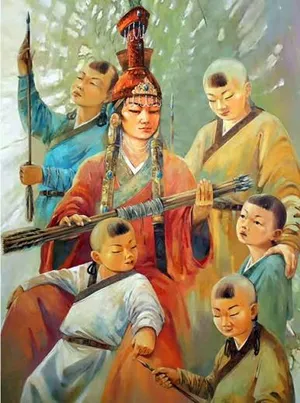
The Mongolian matriarch (10th century, written down in the 13th) The most famous version — and the one with five arrows — is neither Greek nor about a father. In the Secret History of the Mongols, a 13th-century chronicle, the matriarch Alan Gua gives each of her five sons a single arrow to break, then binds the five together and dares them to break the bundle. Her sons, the ancestors of Genghis Khan, get the point. This is almost certainly the "five arrows" version you may have heard.
The tale of the five arrows
The Bulgar khan (7th century) The Byzantine chroniclers Theophanes and Nicephorus recorded that Kubrat, a 7th-century khan of the Bulgars, gave his five sons a bundle of arrows with a warning: stay united or be enslaved. His sons ignored him, split apart, and were conquered one by one by the Khazars — a real kingdom paying the price for the very lesson their father taught.
The Moravian king (late 9th century) The Byzantine emperor Constantine VII wrote in the 10th century that Svatopluk, king of Great Moravia in the 870s–890s, called his three sons and used three bound rods to teach the same lesson. He added a note scholars find telling: the story was already ancient, traceable in writing to pre-Christian Iran. His sons also ignored him; Moravia collapsed within a decade.
The Roman fasces The same image hardened into a political symbol. Roman magistrates carried the fasces — a bundle of rods wrapped around an axe — as the emblem of collective authority. Ironically, the 20th-century Italian Fascist Party adopted the very same symbol, giving a lesson about unity a dark afterlife.
How they spread (briefly) Within Europe the chain is documented: from Greek collections through medieval retellings to the French writer La Fontaine and the Dutch author Pieter de la Court in the 1600s. The real puzzle is the East–West gap — whether the Scythian story reached Mongolia, or whether each steppe culture invented it independently, no one can prove. A 2026 study even argues Alan Gua, the legendary Oghuz Khan, and King Scilurus are the same story lineage — a bold claim, not a settled fact.
A telling detail: arrows vs sticks Look at what each culture reached for. The steppe nomads — the Scythians with spears, the Bulgars and Mongols with arrows — chose the weapons they lived by, while the settled cultures, from Greek farmers to Roman magistrates to Moravian kings, chose sticks and rods from the ground. Even the object of the lesson was localized: a horseman thinks of arrows, a villager of firewood.
That's the beauty of an oral fable. With no author to pin down, it was free to sprout a mother here, a khan there, eighty sons in one telling and five arrows in another — while the core stayed constant: bound together, we do not break.