One Big Beautiful Bill: The Complete Story of Trump and Musk's Year of War and Peace
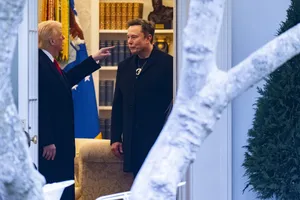
A year ago, the most powerful man in America and the richest man in the world were at war. Today, they take phone calls once a month, dine at the same table, and fly on the same plane. This is the story of how Donald Trump and Elon Musk went from "first buddies" to bitter enemies and back again — and why a single piece of legislation, the "One Big Beautiful Bill," was at the center of it all.
image
The relationship began as a spectacular alliance. Musk spent nearly $300 million helping Trump win the 2024 election, making him the biggest single donor of that campaign. After the victory, Trump rewarded him with a role heading DOGE, the Department of Government Efficiency, a new agency created to slash federal spending. Musk — decked out in a black MAGA hat, jumping on stage at rallies — became a fixture at the White House, so close that both men openly called each other friends.
Then came the bill. Trump's "One Big Beautiful Bill" was a budget reconciliation package — a procedural tool that lets the ruling party pass major legislation with a simple Senate majority instead of the usual 60 votes. Inside its more than a thousand pages were three things Trump urgently wanted: an extension of his 2017 tax cuts (worth roughly $4.5 trillion), a raise of the debt ceiling by $4-5 trillion, and about $350 billion for border enforcement, deportation efforts and defense. Smaller items rode along: tax-free tips and overtime, and the removal of tax credits for electric vehicles, solar and wind.
The bill existed to solve a timer that was about to explode. Trump's 2017 tax cuts, his proudest first-term achievement, were set to expire at the end of 2025 — without action, every American would quietly face higher taxes. On top of that, the federal government had already hit its $36.1 trillion debt ceiling and could not borrow another dollar without Congress raising it. The reconciliation route let Trump bundle his tax promise, the debt limit and his campaign pledges on the border into one unblockable package.
Musk, however, saw the opposite of what he had spent months doing. He had just left DOGE, where he fought to cut federal waste. The bill, according to the nonpartisan Congressional Budget Office, would add about $3.4 trillion to the national debt over a decade. He called it a "disgusting abomination" on his platform X and warned it would push the annual deficit toward $2.5 trillion. There was a personal layer too: the bill killed the electric-vehicle tax credit, directly hurting his company Tesla — a point House Speaker Mike Johnson later made publicly. Musk also carried other grievances: his Starlink push into FAA air-traffic systems had gone nowhere, his ally Jared Isaacman had seen his NASA nomination pulled, and his own wish to stay in government beyond his 130-day limit had been denied.
The feud erupted in public on June 3, 2025. Musk posted a barrage: the bill was "a disgusting abomination," Congress was "making America bankrupt," and voters should "fire all politicians who betrayed the American people." He went further, claiming Trump would have lost the election without him. Trump hit back days later, saying he was "very disappointed," threatening to cancel SpaceX and Tesla government contracts, and accusing Musk of "ingratitude." Musk retaliated by raising Trump's ties to Jeffrey Epstein and suggesting he agreed Trump should be impeached. Tesla's stock dropped more than 14 percent in the turmoil — about $150 billion of market value gone in days.
Cooling began almost immediately. Within days, Vice President JD Vance and White House chief of staff Susie Wiles were on the phone with Musk. He called Trump, deleted his harshest posts — including the Epstein one — and wrote that some of his comments "went too far." The threatened contract cancellations never happened. But the fight was not over: late in June, with the Senate debating the bill, Musk called it a "debt slavery" bill and threatened to found a new political party. It made no difference. On July 4, 2025, Trump signed the bill into law.
The breakthrough came in September, through tragedy. Charlie Kirk, a young conservative activist who had spent months privately urging both men to reconcile, was fatally shot at a speaking event. At his memorial service, Musk walked over to Trump's suite, they shook hands and talked, and Musk posted a photo of the two of them with the caption "For Charlie." It was their first public interaction since the blow-up.
image
The thaw continued step by step. In January 2026, Musk had dinner with Trump and first lady Melania at Mar-a-Lago, posting "2026 is going to be amazing!" In May, he joined Trump on Air Force One for a trip to Beijing — a visibly friendly flight where the two talked about Musk's new factory plans and Trump's questions about space launches. In June, Trump declared they were "friends again." By August, they were speaking about once a month, on topics like AI and China. Behind the scenes, the reconciliation was helped by favors: Trump re-nominated Musk's ally Jared Isaacman to lead NASA, and Musk pledged at least $100 million to help Republicans keep Congress in the November 2026 midterms.
As for the bill itself, it is now law and largely working as designed: the tax cuts were extended, the debt ceiling was raised, and border funding flowed. The electric-vehicle and clean-energy credits were indeed removed, as Musk had feared. Critics point to deep cuts to Medicaid and food assistance — roughly 8 million people projected to lose health coverage — as the price paid, while the added debt remains a live political fight.
Trump reportedly tells aides privately that he and Musk will never be as close as they once were. The relationship has settled into something more honest: an alliance of convenience. Musk's SpaceX holds defense and NASA contracts the government considers essential; Trump needs Musk's money and reach for the midterms. The bill that broke them taught both men the same lesson — in American politics, ideology bends, but interests rarely do.