America's WASP Elite and the Jewish Scapegoat
There is a widely repeated story in American political talk: the Jews run everything. They control the banks, the media, the government. Whenever the economy fails or a war starts, the claim resurfaces — look behind the curtain and you'll find a Jewish hand. This story has been told in Europe and America for centuries, and it has been the justification for some of the worst violence in modern history.
But the story has a flaw that is rarely discussed: it doesn't match the actual structure of American power. The Jews are not running America, and they never were. This article is not an apology for anyone. It is simply a look at who actually holds power, how the United States extracts wealth from the rest of the world, and why a visible minority keeps getting blamed for the failures of an invisible establishment.
Part I: Who Actually Holds Power
American elite power has a center of gravity, and it was fixed long before large-scale Jewish immigration began in the late 19th century. That center is the WASP establishment — White Anglo-Saxon Protestant old money, a term for the families of British Protestant descent who founded the Ivy League universities, the major law firms, the corporate boards, and the charitable foundations. These families have been at the center of American institutions for generations, and their names appear repeatedly in the same schools, clubs, and boardrooms.
Around this core sits the larger machinery: the military-industrial complex (the alliance of the armed forces, the Pentagon, and the defense contractors that profit from weapons spending — the term was coined by President Dwight Eisenhower in 1961), the intelligence agencies, the Federal Reserve (the US central bank, which sets interest rates and prints dollars), the Treasury, and the flagship universities. These institutions are connected by a revolving door: officials move between government posts and private companies so smoothly that the two are difficult to tell apart.
By comparison, Jewish Americans entered the elite much later and through a narrower door. In the mid-20th century, Jewish immigrants and their children moved into the expanding professions — finance, media, entertainment, academia — partly because the old WASP firms and universities often barred them, leaving the newer, faster-growing industries as the open path. They succeeded spectacularly in these fields. But they were joining an existing structure, not creating one. The ownership of the machine — the old money, the defense industry, the central bank, the boards of directors — remained in the hands of families whose names do not appear in conspiracy theories, because they have never needed to appear anywhere.
This is the first point worth understanding: in the American power structure, the most visible people are rarely the most powerful ones.
Part II: How America Extracts Wealth From the World
image
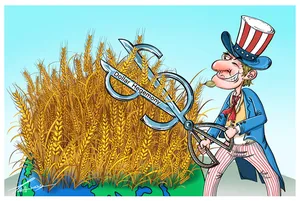
Strip away the ideology, and the United States operates the most efficient extraction system in history. It rests on four pillars.
The financial weapon. The US dollar is the world's main reserve currency — the currency in which international trade and most countries' savings are held. Washington uses this position as a weapon: it can freeze any country's dollar assets, and it can cut any country off from SWIFT, the global payment-messaging system that nearly all international bank transfers rely on. Sanctions of this kind are, in practice, economic war without firing a shot.
The military umbrella. The US maintains roughly 750 military bases abroad and a navy that patrols the world's major shipping lanes. The bases guarantee that global oil trade and the terms of world trade remain set in Washington's favor. Any country that wants to sell freely to the world must first accept American military presence.
The technology monopoly. The plumbing of the modern economy — the internet, the computer-chip supply chain, the cloud services, the search engines — runs through American corporations and American law. US export controls, for example, can restrict what chips a company anywhere in the world may buy, because the design tools and patents are American.
The Wall Street machine. The money flows through the financial capital of New York: the investment banks, the hedge funds, and the pipeline of Treasury secretaries and central-bank chairs who move between Wall Street and Washington. The American state and American financial capital are not rivals; they function as one organism.
None of these pillars requires a Jewish conspiracy. They are institutions, and the institutions are overwhelmingly Anglo-American. The Jewish role in this system is real but specific: Jews are statistically concentrated in finance, media, and academia — a concentration with a documented historical cause (the professions open to them in the early 20th century) and a visible public face. That concentration is what makes them useful — and what makes them vulnerable.
Part III: The Jewish Predicament
For most of the post-war period, from 1945 to the 2008 financial crisis, American power was expanding and the extraction machine delivered steady profits. In good times, no scapegoat is needed, and anti-Semitism stayed at the margins of polite politics.
That period is ending. The US is facing rising competition — China's economic growth, the push by several countries to reduce reliance on the dollar, the shrinking share of global manufacturing. As the harvest shrinks, political movements look for someone to blame, and populist politics in America and Europe have increasingly targeted the visible minority with the historically familiar accusations: control of the media, control of finance, disloyalty to the nation. Attacks on synagogues have risen; slurs once considered unacceptable have returned to public speech.
The Jewish response to this pressure is documented and mostly conventional. Jewish organizations such as the Anti-Defamation League (an advocacy group founded in 1913 to fight anti-Semitism) and AIPAC (the American Israel Public Affairs Committee, a lobbying group) are active and well-funded. Jewish figures in media push back against anti-Jewish rhetoric. Jewish elites marry into the broader establishment, fund universities, and sit on the same boards as everyone else. All of this is normal interest-group politics — the same behavior practiced by every ethnic and religious community in America.
But there is a trap in the situation: every defensive action is cited as further evidence. Lobbying is presented as "control." Media presence is presented as "the media being owned." Philanthropy is presented as "buying influence." A community that defends itself publicly is accused of running the narrative; a community that stays silent is accused of hiding. Either way, the accusation is treated as confirmed. This is a well-documented pattern in the history of anti-Semitism, and it is playing out again now.
Conclusion: The White Glove and the Fall
It is worth being precise about the role being assigned — and the role actually played. The dominant narrative casts the Jews as the masters of the system: the puppet masters behind the banks, the media, and the government. This article argues the opposite: they are not the masters. They are the facade — the visible front of an American power structure whose real owners are the WASP establishment, the defense industry, and the financial revolving door. A facade is by definition disposable: it can be polished when useful, and discarded when the building needs someone to blame. The banks are called "Jewish banks" even when they are run by gentiles; the media is called "Jewish media" even when most of its owners are not Jewish; the financiers who are attacked are Jewish, while the WASP-run defense contractors and the revolving-door officials are simply "the establishment." The old money stays clean; the visible minority takes the blame — and can be made to take it again, whenever the system needs a scapegoat.
History offers a clear sequence for what happens next in such situations, and it has repeated itself with terrible consistency: first, an economic crisis; second, the blame directed at the most visible minority; third, that minority paying for the crisis with its safety, its property, or its life. It happened in the Russian Empire, where Jewish communities were destroyed during economic and political turmoil. It happened in Germany in the 1930s, where the collapse of the economy and the rise of a populist movement ended in the Holocaust. In each case, the deeper establishment survived while the visible target was consumed.
The United States today has the same elements in place: a shrinking economy's benefits, a populist movement looking for enemies, and a visible minority with a documented presence in finance and media. Whether the sequence will repeat is not something anyone can predict with certainty. But it is reasonable to say this: the Jews are not running America, and if the American empire's decline continues, they are the most likely candidates to be made to pay for it.
The tragedy is not only theirs. A society that cannot see its real power structure — the old money, the defense industry, the financial revolving door — will always find a substitute target. And the substitute target, historically, always pays the price.