What Really Drives Political Polarization in America: Beyond Identity Politics
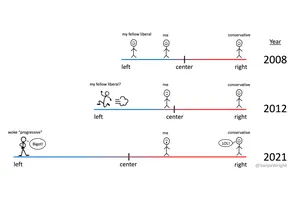
The uncomfortable shift of identity politics. Protecting the rights of minorities is one of the clearest goods in modern politics — same-sex marriage, anti-discrimination law, voting rights. But in recent years the movements built around these causes have quietly changed function. They stopped being about winning rights and started being about detecting loyalty. A rainbow flag or a BLM sign stopped being a statement and became a litmus test: are you with us or against us? "Silence is complicity" means the undecided middle is treated as an enemy. People who genuinely support minority rights find themselves pressured to perform support — because in the social media era, non-display is read as betrayal. Identity politics became a sorting machine.
The Musk trajectory shows how the machine works. No one told Elon Musk to pick a side — but the process pushed him anyway. He backed Obama and Biden, and his companies ran on Democratic-era subsidies. Then the snubs accumulated: excluded from the White House EV summit, attacked over union fights, investigated by Democratic administrations, mocked by the party's base. The message was never spoken aloud, but it was constant: you're not one of us. Within two years he went from a Democratic donor to MAGA's first friend. The sorting machine doesn't operate by force — it operates by exclusion. And it does this to anyone who doesn't fit a camp cleanly, which is exactly how the middle gets squeezed out.
image
The same pattern repeats across every domain. Identity is just the most visible tool in an arsenal of parallel engines:
Economic. Tax policy is a perfect loyalty test — "should the rich pay more?" splits any room and attaches moral weight to the answer. Trade works the same way: tariffs pit globalization's winners against its losers.
Cultural. Guns, abortion, religion are no longer policy debates but identity markers. Abortion especially is built to have no middle answer: it forces a choice and brands the other side evil.
Media. Fox and MSNBC have built two parallel realities where the same event gets opposite factual accounts. When facts themselves split, the middle can't reason its way out — it can only pick a team and believe what the team believes. Legal. Supreme Court appointments have become existential battles, since the Court settles everything from abortion to voting rights. Every vacancy is framed as civilization at stake.
Immigration. Border walls and migrant caravans translate economic anxiety into cultural fear — a formula as old as politics itself: your problem isn't capitalism, it's the outsider.
Geopolitical. China policy and Ukraine aid have become domestic loyalty tests, with both parties competing to be more hawkish. Foreign affairs are now campaign material.
And the money. The old cliché says Republicans are the party of the rich, but the real split is old money vs. new money. Traditional wealth — oil, real estate, manufacturing — leans Republican. New money — tech, hedge funds, Hollywood, Wall Street institutions — funds the Democrats, whose "tax the rich" rhetoric has coexisted awkwardly with billionaire donors since the Clinton years. Money isn't the cause of division; it's the amplifier. Donors fund whoever polarizes most effectively, because polarization wins elections.
All these engines share one design: compress a complex problem into a binary choice, then dress the choice in morality. Once an issue is moralized, the middle can't analyze it — opposing one side means siding with evil. The tools aren't built to persuade; they're built to sort. Behind them sits a structure that rewards this: a two-party system with primaries that reward the loudest base, gerrymandered districts, and algorithmic media that profits from outrage.
The uncomfortable conclusion: American politics isn't broken by bad actors using dirty tricks. The system's optimal strategy is division — whoever manufactures the most effective enemy wins the election. Identity politics, culture wars, and media bubbles are just the weapons in that arsenal.
Does this permanent division lead to civil war? Not in the classic sense. Civil wars need clear geographic fronts, armies choosing sides, and a broken constitutional order — none of which the US currently has. The more accurate forecast is long-term decay, not civil war: a slow-motion decline sustained by its own mechanics.
The cycle feeds itself. Weak tax collection forces deficit spending; rising debt interest eats the budget; services erode; citizens lose faith in institutions; polarization deepens; and reform becomes impossible because any bipartisan fix would cost both parties their base. Politicians are rationally short-sighted — solving long-term problems is political suicide, so everyone defers and blames. Crises have even become routine: government shutdowns, debt-limit standoffs, contested elections — once abnormal, now part of the regular calendar. And when internal pressure peaks, both parties reach for the one consensus move available: manufacturing an external enemy. Foreign hawkishness isn't ideology; it's the system's pressure valve.
The baseline scenario for the next two to three decades, then, is neither collapse nor war, but a country that keeps functioning while steadily losing the ability to govern itself — punctuated by sporadic political violence, with fiscal decay and social division reinforcing each other. The single indicator that matters is the next debt-ceiling crisis or contested election: if the institutions digest it, the country buys itself a few more years. The one they can't digest is the turning point.