Who shapes American politics? A field guide to the interest groups
American politics is often explained with a single name — Wall Street, the lobby, the family. The reality is a landscape of many organized interests, each with its own tools, history, and wins. Here is a field guide to the major players.
WASP old money. The original establishment: White Anglo-Saxon Protestant families who built the country's industrial and financial base in the nineteenth century. The Morgans organized the rescue of the US Treasury in the Panic of 1907 — before the Federal Reserve existed, one private banker was the lender of last resort. The Rockefeller fortune funded the University of Chicago and the Council on Foreign Relations, the think tank that has staffed the foreign-policy establishment for a century.
Their power does not show up in wealth rankings — the Forbes top ten is now all tech founders — because it lives in institutions. The Federal Reserve was designed by Warburg of Kuhn Loeb; Supreme Court justices graduate from law schools shaped by old-money boards; CFR's directorate reads like a family register; Harvard's $50 billion endowment was built on generations of old-money gifts. The private bank Brown Brothers Harriman, serving multi-generational families, has no website to speak of, refuses publicity, and quietly manages billions. Skull and Bones at Yale counts presidents among its secret members. Old money is quiet because it doesn't need to advertise: influence is held through trusts, foundations, and boards, and the money itself never has to appear in public. The new rich show off; the old rich show nothing.
Jewish Americans and the Israel lobby. Jewish influence in finance is centuries old by necessity: European restrictions barred Jews from land and most trades, leaving money-lending as one of the few open doors. German-Jewish bankers built Goldman Sachs, Lehman Brothers, and Kuhn Loeb in the nineteenth century, and Paul Warburg of Kuhn Loeb helped design the Federal Reserve Act of 1913. In the twentieth century, Jewish Americans held the Treasury under Roosevelt (Henry Morgenthau) and three consecutive Fed chairs (Greenspan, Bernanke, Yellen). AIPAC, founded in 1963, is widely rated the most effective foreign-policy lobby in Washington; its signature achievement was defeating President Carter's sale of AWACS planes to Saudi Arabia in 1981 and securing decades of uninterrupted military aid to Israel.
The military-industrial complex. Eisenhower's 1961 farewell address named it before anyone else: a permanent alliance of defense contractors, the armed services, and their congressional patrons. Its history is written in every American war since — the Vietnam-era procurement scandals, the endless post-9/11 budgets, the F-35 program that keeps expanding despite decades of cost overruns. Defense money flows through nearly every congressional district, which is why base closures and weapons cancellations are among the hardest votes in Washington.
Gulf money. Saudi Arabia, the UAE, and Qatar each maintain sprawling lobbying and public-relations operations, often working against each other. The Saudis' post-9/11 image campaign was one of the most expensive influence efforts in history; the UAE spent heavily to secure the nuclear deal and F-35 sale that the Saudis then demanded for themselves. Even the murder of journalist Jamal Khashoggi in 2018 — which triggered public condemnation — did not stop arms sales worth billions, a demonstration of how durable institutional lobbying can be.
The new individual players. The old categories assumed power belonged to organizations. Elon Musk broke the mold: one person combining a defense contractor (SpaceX), a social media platform (X), a carmaker (Tesla), and an AI lab (xAI) — then spending hundreds of millions to help elect a president and taking a seat inside the government as head of the Department of Government Efficiency. He is the prototype of a new category: the super-individual, whose influence scales with personal wealth, reach, and access.
Musk is not alone in this lane — the super-individual has four distinct playbooks:
- The office-seeker (Musk): own the industry and the platform, then take the job yourself. Direct access, direct power. - The network-builder (Thiel, Soros, Koch): Peter Thiel turned Palantir into a defense and intelligence contractor and seeded the political career of Vice President J.D. Vance from a single investment round. George Soros built a global foundation network that funds thousands of organizations across every continent. Charles Koch built Americans for Prosperity into a machine that disciplines Republican primaries. Instead of holding office, they place people and fund movements. - The gatekeeper (Murdoch, Bloomberg): Rupert Murdoch's Fox News has set the agenda of the American right for three decades; Michael Bloomberg combined a news empire with a $1 billion self-funded presidential run. Control the information pipe, and you control what the debate is about. - The rule-maker (Altman, Ellison): Sam Altman turned OpenAI's dominance into a seat at the table for AI regulation; Larry Ellison's Oracle is embedded in the federal AI infrastructure push. Write the rules for the technology everyone else depends on.
image
What these men share is what organizations lack: speed, single-decision power, and the ability to change direction without a committee. The nineteenth century had its railroad barons and robber barons; the twenty-first century's version also owns the platform, the pipeline, and sometimes the government itself.
Latino voters. The largest minority bloc, nearly a fifth of the population. The Cuban American community of South Florida is the classic case: organized, concentrated, and single-issue, it has kept the US embargo on Cuba in place for over sixty years, outlasting a dozen presidential administrations. Mexican American voters anchor the Democratic coalition in California, Texas, and the Southwest.
Evangelical Christians. A quarter of Americans call themselves evangelical, and they form the most reliable base of the Republican coalition. Their political wins include the reversal of Roe v. Wade and the conservative remaking of the Supreme Court. Less known abroad: Christian Zionism — the belief that supporting Israel fulfills biblical prophecy — is the largest mass base of American support for Israel, outnumbering Jewish voters by more than ten to one, and was a driving force behind moving the US embassy to Jerusalem in 2018.
Black Americans. The most loyal Democratic constituency, organized through the Congressional Black Caucus. The civil rights legislation of the 1960s was the movement's greatest victory; since then the CBC has functioned as a disciplined voting bloc that no party leader can ignore on issues from voting rights to criminal justice.
The AARP. Forty million members, mostly retirees, organized around two issues: Social Security and Medicare. Its power was demonstrated in 2005 when it helped sink George W. Bush's plan to partially privatize Social Security — a proposal with majority support at the time, defeated by one organized interest group.
Labor unions. The UAW, teachers' unions, and the AFL-CIO provide the Democratic Party's ground game in industrial states. The 2023 UAW strike against the Big Three automakers won major wage increases and is the modern case study of union power; union households remain decisive in Michigan and Pennsylvania.
Big tech. Google, Meta, and Amazon have gone from political novices to top-tier lobbyists in a decade. Their signature achievement is defensive: despite years of antitrust complaints from both parties, no major tech breakup bill has passed — a record of successful obstruction that rivals any traditional industry.
The NRA. The most feared single-issue group in American politics. It defeated the assault weapons ban's renewal in 2004, blocked background-check legislation after every mass shooting, and reshaped the Supreme Court's interpretation of the Second Amendment through the Heller decision.
Smaller ethnic lobbies. The Armenian diaspora spent decades lobbying for official recognition of the Armenian genocide; the US government finally acknowledged it in 2021. The Greek lobby has anchored American support for Greece against Turkey in the Aegean disputes. Indian Americans have built USINPAC into a rising force, helped by the community's rapid rise in tech and politics.
Foreign lobbies beyond the Gulf. Taiwan, Japan, and India maintain sophisticated Washington operations; Turkey, Greece, and Armenia fight a three-way lobbying war. Nearly every country with money and interests in Washington runs one — that is the system working as designed.
Are the new money reshaping America? Partly — they have rewritten the tools of power. Wealth rankings are now dominated by tech founders; Musk governs from inside the cabinet; Zuckerberg controls the default communication layer; the AI labs write the rules of the next economy. But the structure of power has barely moved. Old money responded to every previous wave the same way it responds to this one: by absorption. The robber barons of the nineteenth century became the philanthropists of the twentieth — their children attended the same schools, joined the same clubs, married into the same families. The cycle is already repeating: Musk's children attend old-money schools, OpenAI's board sits comfortably inside the establishment network. New money always imagines it is replacing the system; it usually ends up being absorbed by it. Twenty years from now, the Musk foundation will look like the Rockefeller foundation, and a new outsider will be demanding to know why the old guard runs everything.
How strong is old money, exactly? Strong enough that it doesn't need to appear anywhere. The new rich are applications running on the surface of American life; old money is the operating system underneath. It staffs the Federal Reserve, writes the foreign-policy consensus through CFR, shapes the law through endowed universities, and channels policy through think tanks it funds — all without a single family name in the news cycle. The power of old money is that it never has to show up: its wealth sits in trusts, its influence sits in institutions, and its identity sits in the clubs and law firms that keep no public records. That is the real answer to "how strong" and "how quiet" — it is strong precisely because it is quiet, and it is quiet because it does not need to be anything else.
image
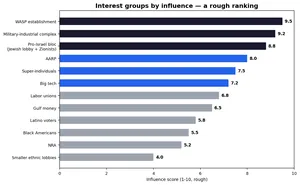
Ranking them by influence. Any ranking is an argument, but by the standard of organized resources, historical wins, and institutional access, a rough order looks like this:
1. WASP establishment — sets the frame, owns the institutions, invisible but first 2. Military-industrial complex — a permanent constituency with a permanent budget 3. The pro-Israel bloc: Jewish lobby + Christian Zionism — the elite layer (AIPAC, finance, Fed chairs) plus the mass base (evangelicals, a quarter of the population, ten times the Jewish vote), together the most successful foreign-policy coalition in Washington 4. The AARP — veto power over retirement policy 5. Super-individuals (Musk model) — new, but one person with a platform and a cabinet seat 6. Big tech — money and platforms, blocked every antitrust attempt 7. Labor unions — decisive in swing states, shrinking but still essential 8. Gulf money — deep in one lane: arms and Middle East policy 9. Latino voters — largest minority, but low organization and turnout 10. Black Americans — loyal, powerful within one party 11. The NRA — fearsome but in decline 12. Smaller ethnic lobbies — precise, narrow, occasional wins
image
The picture that emerges is not one master. It is a crowded arena where each group — ethnic, religious, industrial, foreign, individual — plays the same game: votes where they can, donations where they can't, lobbying everywhere. The winning groups are not the ones with the most people or the most money, but the ones that are best organized around a clear interest. That is the only pattern that holds across all of them.